How to Use ChatGPT: Complete Beginner’s Guide for 2026 If you have heard people talking about ChatGPT but…
AI Agents vs Chatbots: What’s the Difference in 2026?
Artificial intelligence is moving beyond simple question-and-answer systems. Today, businesses and individuals hear about AI agents, AI assistants and chatbots—terms that are often used interchangeably even though they can describe different technologies.
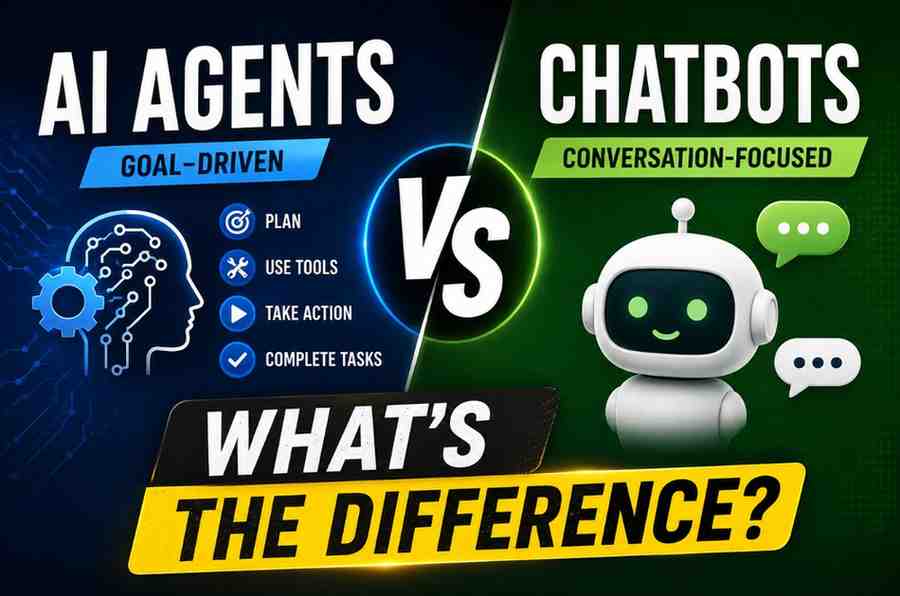
A chatbot can answer questions and hold a conversation. An AI agent can go further by understanding a goal, planning steps, using tools, making decisions within its permissions and completing parts of a task.
Table of Contents
- What Is a Chatbot?
- What Is an AI Agent?
- AI Agents vs Chatbots: The Main Difference
- How Do Chatbots Work?
- How Do AI Agents Work?
- AI Agents vs Chatbots Comparison
- Real-World Examples
- How AI Agents Can Be Used in Business
- When Should You Use a Chatbot?
- When Should You Use an AI Agent?
- Can a Chatbot Become an AI Agent?
- Are AI Agents Going to Replace Chatbots?
- The Future of AI Agents and Chatbots
- Final Verdict
What Is a Chatbot?
A chatbot is a software system designed to communicate with users through conversation. Modern AI chatbots can understand natural language, remember context within a conversation, summarize documents, generate content and answer questions. The basic interaction remains: User asks → AI responds.
What Is an AI Agent?
An AI agent is an AI system designed to work toward a goal rather than simply respond to individual messages. Depending on its design and permissions, an agent can understand an objective, break a task into steps, decide what needs to be done, use external tools, access permitted data, call APIs, perform actions, check results and continue until the task is completed or needs human input.
AI Agents vs Chatbots: The Main Difference
The simplest distinction is: A chatbot primarily responds to conversations. An AI agent is designed to accomplish goals.
For example, a chatbot can answer a restaurant’s closing time. An AI agent with access to a booking system could potentially check availability and make a reservation. The chatbot provides information; the agent can take action.
How Do Chatbots Work?
A modern chatbot generally receives user input, interprets the request, considers available context, generates a response and returns it. The process can be summarized as Message → Understand → Generate → Respond. This makes chatbots useful for FAQs, customer support, writing assistance and general information.
How Do AI Agents Work?
AI agents add goal-directed behavior and tool use. A simplified workflow is Goal → Plan → Use Tools → Perform Actions → Check Results → Complete Task. An agent might access a CRM, search permitted sources, classify information, prepare a report and route the result to a human.
AI Agents vs Chatbots Comparison
| Feature | Chatbot | AI Agent |
|---|---|---|
| Conversation | Yes | Yes |
| Answers questions | Yes | Yes |
| Generates content | Yes | Yes |
| Uses external tools | Sometimes | Often |
| Performs actions | Limited | Core capability |
| Plans multiple steps | Limited | Yes |
| Works toward a goal | Limited | Yes |
| Automates workflows | Limited | Strong |
| Best for | Conversation and support | Tasks and automation |
Not every system is purely a chatbot or purely an agent. Some modern chatbots can use tools, while some agents include a conversational interface. The difference is better understood as a spectrum.
Real-World Examples
Customer Support
A chatbot can explain a return policy. An AI agent could potentially locate an order, verify return eligibility and create a return request when connected to the necessary systems.
Online Shopping
A chatbot can answer product questions. An agent could potentially search permitted sources, compare products against several requirements and prepare recommendations.
Business Leads
A chatbot can explain services. An AI agent could potentially review new inquiries, identify promising prospects and prepare follow-up messages when connected to the appropriate CRM and email tools.
Content Creation
A chatbot can write an article. An agentic workflow could research a topic, prepare an SEO outline, draft content, create metadata and save a WordPress draft if those tools are connected.
How AI Agents Can Be Used in Business
Potential business applications include sales lead qualification, customer support, marketing research, document processing, reporting, e-commerce assistance and internal knowledge workflows. For sensitive financial, legal, security or high-impact decisions, appropriate human review and controls remain important.
When Should You Use a Chatbot?
A chatbot is usually the better choice when the main requirement is conversation. It can work well for FAQs, website support, product information, lead collection, appointment questions, troubleshooting and general assistance. There is little benefit in building a complex agent when a simple conversational system solves the problem.
When Should You Use an AI Agent?
An AI agent makes more sense when the system needs to complete multiple steps, use external tools, access business systems, search different sources, update records, trigger workflows or monitor information. The key requirement is moving from answering to accomplishing a task.
Can a Chatbot Become an AI Agent?
A chatbot can be expanded with database access, APIs, search, CRM integrations, email tools, scheduling and workflow automation. However, simply adding tools does not automatically create a sophisticated agent. Agentic systems generally combine goal-directed behavior, planning, tool use, state management and decision-making.
Are AI Agents Going to Replace Chatbots?
Probably not. Simple chatbots will remain useful because many businesses do not need complex automation. A customer asking for business hours does not require an advanced agent. For more complicated requests, an agent can provide greater value. The two technologies will likely continue to overlap.
The Future of AI Agents and Chatbots
The bigger shift is from AI that answers toward AI that works. Users may increasingly describe an outcome and let an AI system coordinate several steps across connected applications. Humans will still need to supervise important decisions and sensitive actions. The goal is to reduce repetitive work while keeping people responsible for judgment and accountability.
Final Verdict
Chatbots are primarily designed to talk. AI agents are designed to accomplish tasks.
A chatbot is useful when you need information, conversation or basic assistance. An AI agent becomes more valuable when you want a system to plan, use tools and take actions toward a goal.
Neither technology is automatically better. The right choice depends on the problem. For a simple FAQ website, a chatbot may be enough. For a workflow involving research, CRM systems, email, documents and multiple steps, an AI agent may provide much greater value.
The important change is the move from “Here is an answer” to “Here is what I can help you accomplish.”