How to Use ChatGPT: Complete Beginner’s Guide for 2026 If you have heard people talking about ChatGPT but…
GPT-5.6 vs Gemini 3.6: Which AI Is Better in 2026?
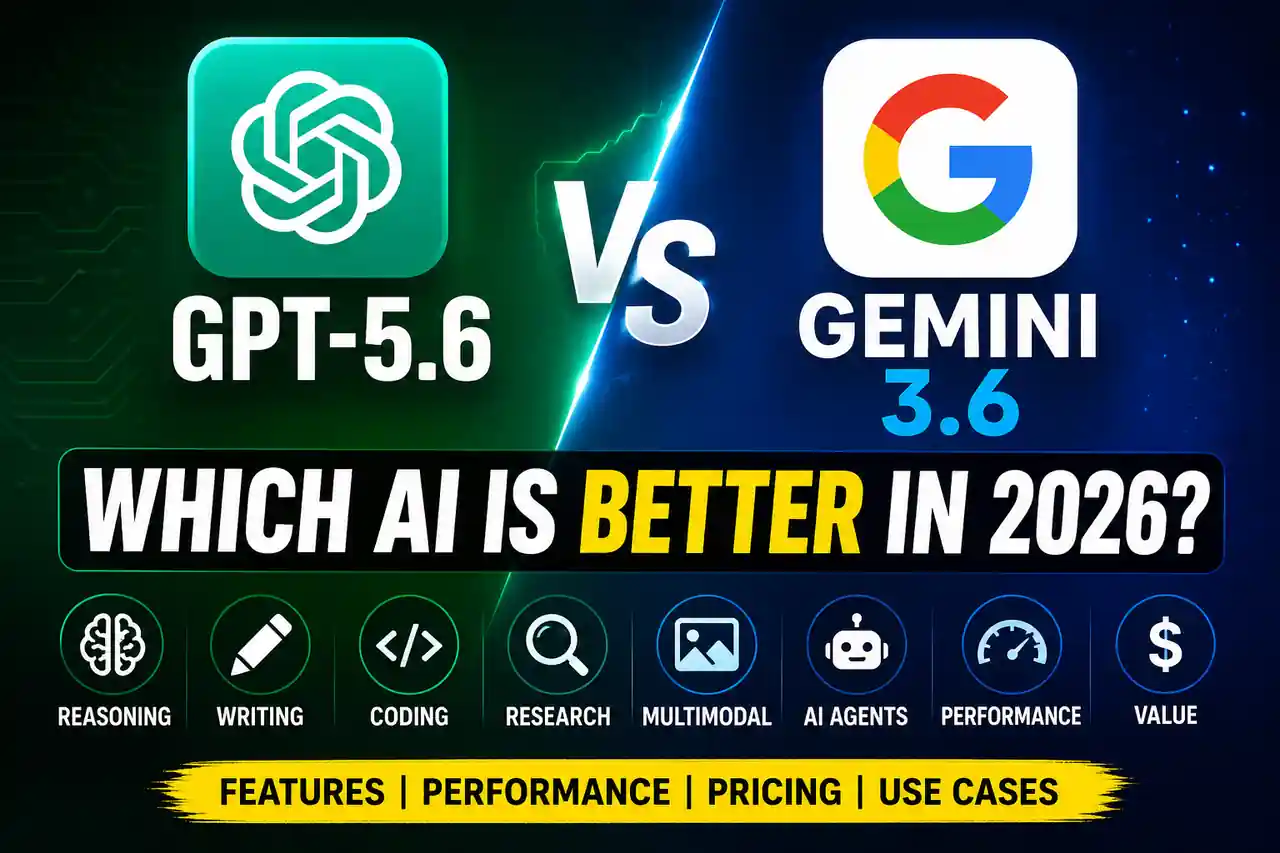
Artificial intelligence is moving rapidly in 2026, and two of the biggest names in the AI race are OpenAI and Google. OpenAI launched the GPT-5.6 family in July 2026, while Google introduced Gemini 3.6 Flash later that month. Both are designed to handle demanding work, but they take different approaches to performance, efficiency, tools and AI agents.
So which one is better? The practical answer is that there is no universal winner. The better AI depends on what you want to accomplish.
GPT-5.6 vs Gemini 3.6 at a Glance
| Area | GPT-5.6 | Gemini 3.6 Flash |
|---|---|---|
| Complex reasoning | Excellent | Very strong |
| Writing | Excellent | Excellent |
| Coding | Excellent | Excellent |
| Research and knowledge work | Excellent | Very strong |
| Multimodal work | Strong | Strong |
| AI agents | Excellent | Excellent |
| Efficiency | Strong | A major focus |
| Best fit | Complex professional work | Fast, scalable agentic and multimodal workflows |
What Is GPT-5.6?
OpenAI announced the GPT-5.6 family on July 9, 2026. The family includes GPT-5.6 Sol as the flagship model, GPT-5.6 Terra as a balanced option and GPT-5.6 Luna as a faster, more affordable tier. OpenAI says the family is designed for coding, knowledge work, science, cybersecurity, computer use and complex end-to-end workflows.
One of the biggest themes around GPT-5.6 is getting more useful work from every token. OpenAI also introduced stronger computer-use and multi-agent capabilities for demanding workflows.
What Is Gemini 3.6 Flash?
Google introduced Gemini 3.6 Flash on July 21, 2026. Google describes it as a workhorse model focused on coding, knowledge work and multimodal performance, with particular attention to token efficiency, latency and reliability for AI agents.
That makes Gemini 3.6 Flash especially interesting for developers and businesses that want to build AI-powered workflows at scale without sacrificing speed.
GPT-5.6 vs Gemini 3.6 for Writing
Both models are capable writing assistants. They can help with articles, emails, summaries, rewriting, brainstorming and structured content.
GPT-5.6 is a strong choice when a task requires detailed instructions, complex reasoning and a polished final output. Gemini is also highly capable and can be attractive when writing is part of a larger Google-connected or multimodal workflow.
Winner: There is no universal winner. Choose based on the workflow and the tools you already use.
GPT-5.6 vs Gemini 3.6 for Coding
Coding is one of the most competitive areas of AI. GPT-5.6 is designed for complex programming and long-running technical tasks, while Google says Gemini 3.6 Flash improves coding performance while reducing output-token usage compared with its previous Flash generation.
For developers, the best choice may depend on the programming language, repository, tools, context window, speed requirements and IDE or agent integration.
Winner: Both are strong. GPT-5.6 is particularly compelling for complex reasoning-heavy development, while Gemini 3.6 Flash is attractive when efficiency and speed are priorities.
GPT-5.6 vs Gemini 3.6 for Research
A useful AI research assistant needs more than fluent writing. It needs to understand the question, reason over information, identify uncertainty and present conclusions clearly.
GPT-5.6 is positioned strongly for professional knowledge work and complex research tasks. Gemini’s growing agent and multimodal ecosystem also makes it useful for research workflows that involve multiple tools or types of information.
For important research, users should still verify claims against primary sources. AI can make mistakes even when an answer sounds confident.
Which Is Better for AI Agents?
AI agents are becoming one of the biggest themes in 2026. Instead of simply answering a question, an agent can reason through a task, use tools and complete multiple steps.
OpenAI is building GPT-5.6 around complex agentic work, including programmatic tool calling and multi-agent workflows. Google is also heavily focused on agents, and its Gemini 3.6 Flash launch emphasizes low latency, token efficiency and reliable performance for agents at scale.
Winner: Too close to call. The real deciding factor is the agent platform, tools and integrations surrounding the model.
Which Is Better for Students?
Both can be useful learning assistants. They can explain difficult concepts, generate practice questions, help organize research and support coding practice.
The best way to use AI for education is as a tutor rather than an answer machine. Instead of asking AI to complete an assignment, ask it to explain the concept, show an example and test your understanding.
Which Is Better for Business?
Businesses increasingly want AI that can do more than generate text. They want systems that can analyze documents, work with data, automate repetitive tasks, support employees, write reports and connect to other software.
GPT-5.6 is positioned strongly for professional knowledge work and complex workflows. Gemini 3.6 Flash is particularly interesting for organizations that prioritize efficient, fast and scalable agentic workflows.
The best business choice should be based on the tools your company already uses, security requirements, pricing, integration options and the specific tasks you want to automate.
GPT-5.6 vs Gemini 3.6: Which Should You Choose?
Choose GPT-5.6 if you mainly need:
- Advanced reasoning
- Complex writing and analysis
- Programming assistance
- Professional knowledge work
- Long-running technical workflows
- Advanced agentic tasks
Choose Gemini 3.6 Flash if you mainly need:
- Fast AI workflows
- Efficient agentic applications
- Coding and knowledge work
- Multimodal workflows
- Scalable AI applications
- Google-connected workflows
So, Which AI Is Better in 2026?
If you want a simple answer, GPT-5.6 is an excellent choice for complex reasoning, coding and professional knowledge work. Gemini 3.6 Flash is an excellent choice for efficient, fast and scalable AI workflows, especially where agents and multimodal tasks are important.
But there is no permanent winner. AI models are being updated quickly, and the best model for one task may not be the best model for another.
The smarter question is not “Which AI is smarter?” but “Which AI is better for the work I need to do?”
Final Verdict
GPT-5.6 and Gemini 3.6 show how the AI competition is changing. The focus is no longer just on chatbot answers. It is increasingly about reasoning, tools, agents, multimodal capabilities, efficiency, integrations and the ability to complete real-world work.
NafisFlahi Verdict: There is no universal winner. GPT-5.6 is a strong choice for complex professional work, while Gemini 3.6 Flash is a compelling option for fast, efficient and scalable agentic workflows.
AI models, features and pricing can change quickly. Always check the latest official information before making decisions based on this comparison.