
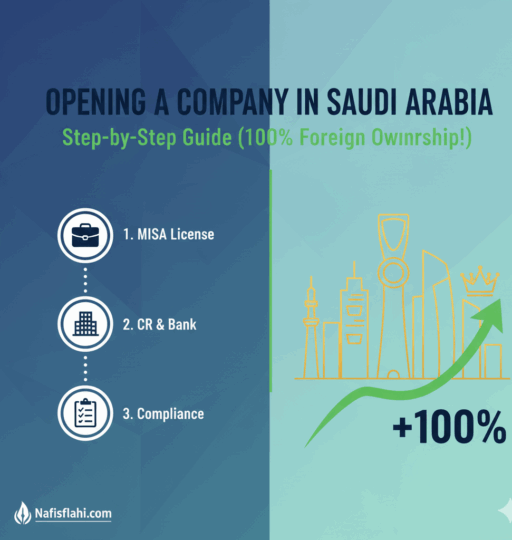
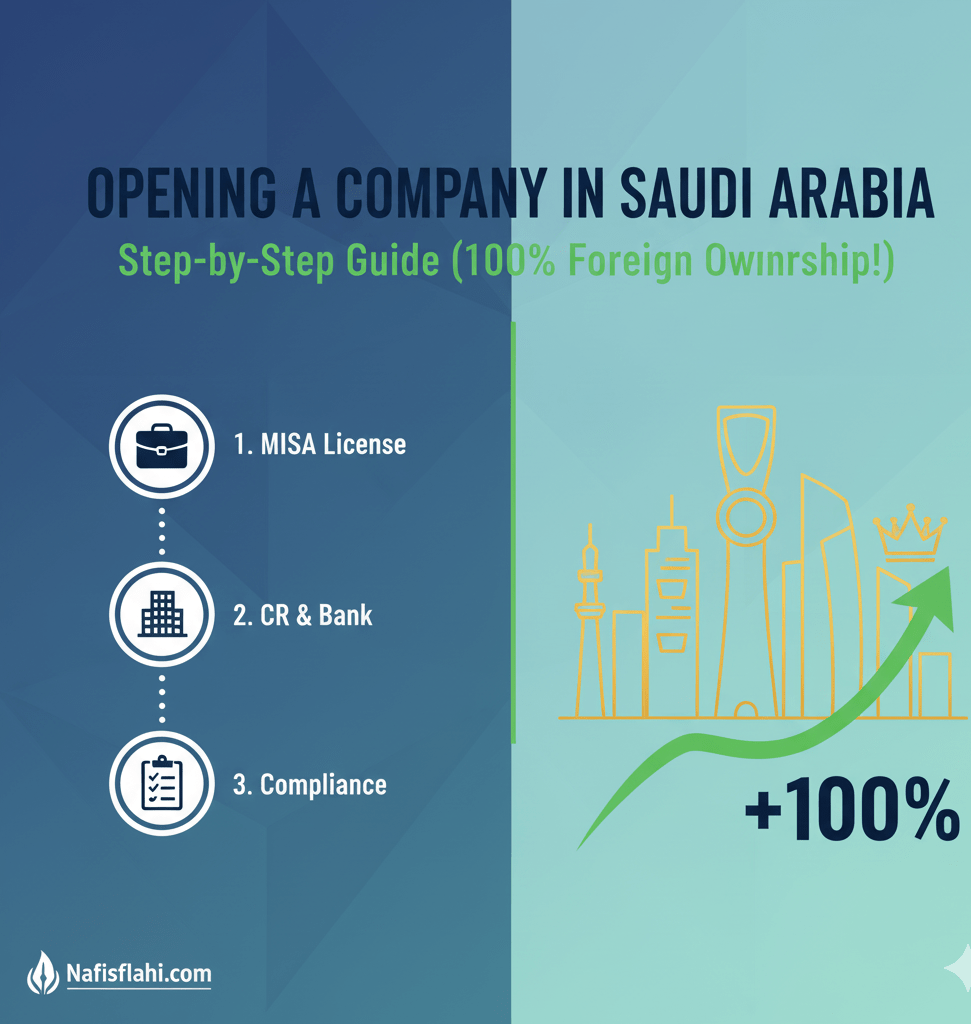
As everyday bloggers and online entrepreneurs, we’re always looking for new horizons. While making money online is global, sometimes a strategic physical presence or formal entity in a rapidly growing market can unlock massive opportunities. And few markets are growing as fast as Saudi Arabia (KSA).
Under its ambitious Vision 2030, Saudi Arabia has thrown open its doors to foreign investment, now allowing 100% foreign ownership in most sectors. This isn’t just for mega-corporations; even small to medium-sized businesses and specialized online services can benefit.
If you’ve ever considered expanding your digital ventures or even setting up a physical presence in the Middle East, KSA offers compelling incentives. But where do you start? This guide breaks down the process into clear, actionable steps.
Phase 1: The Foundation – Planning & Getting Your MISA License
Think of this as your “pre-launch” phase. It’s all about getting your official permission to operate.
- Define Your Business Activity & Structure:
- What exactly will your company do in Saudi Arabia? (e.g., offer digital marketing services, develop software, import goods, etc.). Be specific.
- For most foreign investors, a Limited Liability Company (LLC) is the most common and recommended legal structure due to its flexibility and protection.
- Obtain Your MISA Investment License:
- This is the golden ticket to operate as a foreign investor. It’s issued by the Ministry of Investment of Saudi Arabia (MISA).
- What MISA needs from you: A solid business plan, financial statements (usually 1-2 years audited) from your existing company (if applicable), and notarized/translated corporate documents from your home country.
- Pro Tip: This step can be complex due to document attestation requirements. Seek local legal counsel for smooth navigation.
- MISA Application Submission: You’ll submit all documents via the MISA online portal. Once approved, you’ll officially receive your investment license. Boom! You’re officially on the KSA radar.
This is the foundational step, granting you the official right to invest and operate as a foreign entity in the Kingdom.
| Step | Action | Key Requirements & Notes |
| 1. Determine Activity & Structure | Decide on your legal structure (usually LLC) and define your specific business activities. | Ensure your activity is not on KSA’s “negative list” (restricted sectors). |
| 2. Prepare Foreign Documents | Gather all required corporate documents from your home country. | This typically includes your home country’s Commercial Registration, Articles of Association, Audited Financial Statements (usually for the last fiscal year), and a Board Resolution to establish the KSA entity. Crucially, all foreign documents must be attested by the Saudi Embassy in your home country and translated into Arabic. |
| 3. Apply for MISA License | Submit your application via the Ministry of Investment of Saudi Arabia (MISA)‘s online portal (Invest Saudi). | You will also need to submit a Business Plan outlining your investment, expected job creation, and economic benefits. The license approval usually takes 5–10 business days if documents are complete. |
Phase 2: Building Your Company – Registration & Commercial Setup
With your MISA license in hand, it’s time to formalize your company.
- Reserve Your Company Name: Head to the Ministry of Commerce (MoC) portal to ensure your chosen company name (in both Arabic and English) is unique and available.
- Draft & Notarize Articles of Association (AoA): This is your company’s constitution. It outlines ownership, management, and objectives. Get this professionally drafted and then notarized to make it legally binding.
- Obtain Your Commercial Registration (CR): This is your company’s birth certificate! Submit your MISA license, notarized AoA, and other paperwork to the MoC. The CR is your official proof of incorporation.
- Register with the Chamber of Commerce (CoC): Mandatory membership that legitimizes your business for official transactions within KSA.
- Open a Corporate Bank Account: Take your shiny new CR and MISA license to a local bank (e.g., Al Rajhi, SABB, SNB). You’ll typically need to deposit your initial share capital (which for most LLCs is quite manageable).
Once you have the MISA license, you officially register your company with the Ministry of Commerce (MoC).
| Step | Action | Key Requirements & Notes |
| 4. Reserve Trade Name | Apply to the Ministry of Commerce (MoC) to reserve your desired company name. | The name must be unique and comply with Saudi naming regulations. |
| 5. Draft & Notarize AoA | Draft the company’s Articles of Association (AoA) in Arabic. This legally defines the structure, management, and objectives. | The AoA must be notarized by an authorized Notary Public in KSA. |
| 6. Obtain Commercial Registration (CR) | Submit the MISA License, Notarized AoA, and General Manager’s details to the MoC. | The CR is your official certificate of incorporation and is required for nearly all subsequent steps. |
| 7. Open Corporate Bank Account | Take your MISA License and CR to a local Saudi bank to open a corporate account. | Capital Requirement: While some sectors have no minimum capital, a common minimum for foreign-owned LLCs is SAR 500,000 or as specified by MISA depending on the activity. This capital may need to be deposited and confirmed by the bank. |
| 8. Register with Chamber of Commerce (CoC) | Mandatory registration with the local CoC. | This step finalizes your official commercial presence. |
Phase 3: Launch & Grow – Post-Incorporation & Compliance
You’re almost ready to start trading! These final steps ensure you’re fully compliant with local regulations.
- Secure a Physical Office: Unlike some offshore jurisdictions, a physical office (lease agreement) is generally mandatory for mainland LLCs in Saudi Arabia.
- Register with ZATCA (Tax Authority): Your company will be subject to a 20% Corporate Tax on net profits, and you’ll need to register for VAT (15%).
- Register with HRSD and GOSI (Labor & Social Insurance): If you plan to hire locally, you must register with the Ministry of Human Resources and Social Development (HRSD) and the General Organization for Social Insurance (GOSI). This also starts your journey with Saudization (Nitaqat), which is KSA’s nationalization scheme.
- General Manager’s Visa & Iqama: Your appointed General Manager (who doesn’t have to be Saudi) must complete their residency permit (Iqama) process and register with local government platforms like Absher and Qiwa.
The final phase involves registering with tax and labor authorities to ensure full compliance before beginning operations.
| Step | Authority / Platform | Purpose |
| 9. Register with ZATCA | Zakat, Tax and Customs Authority | Mandatory registration for taxes: Corporate Tax (20%) on net profits for foreign shareholders and VAT (15%) if your annual taxable supply exceeds SAR 375,000. |
| 10. Register with HRSD & GOSI | Ministry of Human Resources and Social Development (HRSD) and General Organization for Social Insurance (GOSI) | Mandatory for labor compliance, securing work visas, and registering employees for social insurance. This is also where you manage Saudization (Nitaqat) compliance. |
| 11. Secure Office & Permits | Municipality & Saudi Post (SPL – Wasel) | A physical office is mandatory for mainland LLCs. Virtual offices are not permitted. You must register the official address with the Saudi Post (Wasel) and obtain any necessary Municipal Operating Licenses (depending on the business type). |
| 12. Appoint GM & Obtain Visa | Ministry of Interior / Muqeem | Appoint a General Manager (GM). If the GM is a foreigner, you must apply for their work visa and residency permit (Iqama) to legally manage the company. |
Why Consider Saudi Arabia NOW?
Beyond the streamlined process, KSA offers a rapidly growing economy, massive government investment in new projects (NEOM, Red Sea Project), and a young, digitally-savvy population. For online businesses, this represents a huge potential customer base and a hub for regional expansion.
Opening a company in Saudi Arabia is a strategic move that can diversify your business and tap into one of the world’s most dynamic markets. It requires careful planning and adherence to regulations, but the rewards for the “everyday blogger” with bigger ambitions can be immense.