
A practical guide for small businesses that want a clear, trustworthy and affordable online presence without unnecessary complexity.
How to Start an Export Business from India: Complete Guide 2026
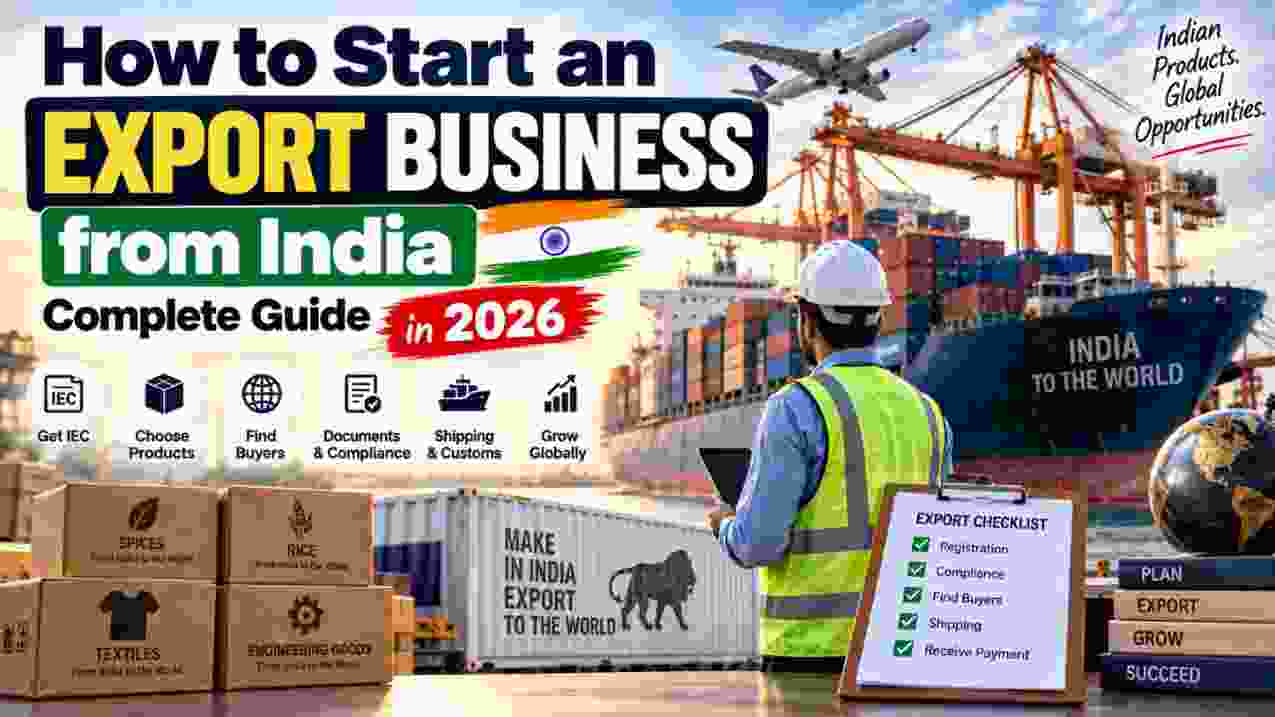
Starting an export business from India can be a good opportunity, but it is not as simple as finding a product, finding a buyer and sending the goods overseas.
There are several things you need to understand first. You need to choose the right product, research the target market, set up your business properly, understand the Importer Exporter Code (IEC), check product-specific requirements, find genuine buyers, agree on payment and shipping terms, prepare documents and complete the required customs procedures.
The good news is that you don’t have to figure everything out at once. If you approach the process step by step, international trade becomes much easier to understand.
This guide explains how to start an export business from India in practical terms, especially if you are a beginner and want to understand what happens before, during and after your first shipment.
Important: Export requirements depend on the product, destination country and transaction. Government rules, documentation and procedures can change, so always verify the current requirements before accepting an order or shipping goods.
Table of Contents
- What Is an Export Business?
- Is Export Business Profitable in India?
- Choose a Product Before You Start
- Research Your Target Country
- Set Up Your Business
- Get an Importer Exporter Code (IEC)
- Check Product-Specific Export Requirements
- Find International Buyers
- How to Verify an Overseas Buyer
- Send Samples and Confirm Specifications
- Calculate Your Export Price
- Understand Incoterms
- Choose the Right Payment Method
- Prepare Your Export Documents
- Arrange Packaging and Shipping
- Understand Customs Clearance
- Receive Payment and Complete the Transaction
- How Much Money Do You Need to Start?
- Common Mistakes New Exporters Make
- Example: Exporting Rice From India
- Export Business Checklist
- Frequently Asked Questions
- Final Thoughts
What Is an Export Business?
An export business is simply the business of selling goods or services from India to customers in another country.
For a product-based business, the basic process can look like this:
Indian supplier → Exporter → International buyer → Destination country
The exporter may manufacture the goods personally or purchase them from an Indian manufacturer or supplier, depending on the business model.
For example, an exporter could source rice from an Indian rice mill and sell it to a distributor in Saudi Arabia. Another exporter might source textiles from manufacturers in India and supply them to a clothing company in Europe.
The product and market can be different, but the basic principle remains the same: you are supplying an overseas customer while meeting the applicable Indian and destination-country requirements.
Is Export Business Profitable in India?
It can be profitable, but there is no fixed profit margin and no guarantee of success.
Your actual profit depends on several factors, including product cost, supplier pricing, selling price, freight, packaging, insurance where applicable, bank charges, documentation costs, inspection or certification costs, exchange-rate movements, payment terms, buyer requirements, and taxes or duties applicable to the transaction.
One of the biggest mistakes beginners make is looking only at the purchase price and selling price. Before accepting an order, calculate the complete cost of the transaction.
Choose a Product Before You Start
Choosing the product is one of the most important decisions you’ll make. Don’t select something simply because someone says it is a hot export product.
Ask whether you can get consistent quality, find reliable suppliers, identify genuine overseas demand, compete on price or quality, export the product under current rules, and make a reasonable margin after all costs.
India exports a huge range of products, including agricultural products, rice, spices, textiles, garments, engineering goods, handicrafts, chemicals and many other categories.
The best product for one exporter may be completely wrong for another. If you already have experience in a particular industry, that can be an advantage.
Research Your Target Country
Finding a product is only half of the job. You also need to decide where you want to sell it.
Look at existing demand, competitors, import requirements, product standards, packaging requirements, local prices, shipping costs, potential distributors, payment practices and market regulations.
You should also find out whether the destination country has special requirements for your particular product. Indian export rules and the destination country’s import rules are two different things, and both need to be considered.
Set Up Your Business
Before you start commercial exporting, you need an appropriate business setup. Depending on your situation, you might operate as a proprietorship, partnership, LLP or company.
The right structure depends on your circumstances, liability preferences, partners, financing needs and long-term plans.
You should also arrange the appropriate banking facilities for your business. International trade involves receiving payments, foreign exchange, transaction records and documentation, so working with a bank familiar with export transactions can be useful.
Get an Importer Exporter Code (IEC)
The Importer Exporter Code (IEC) is one of the key registrations to understand when starting an export business in India.
DGFT guidance states that persons intending to import or export generally need an IEC, subject to specified exemptions. The IEC application and related procedures are handled through the Directorate General of Foreign Trade.
Before applying, check the latest DGFT requirements because application procedures and requirements can be updated.
If you’re completely new to IEC, read our detailed guide: Process To Apply Import Export Code IEC.
Check Product-Specific Export Requirements
Getting an IEC does not mean every product can automatically be exported without additional requirements.
India’s export policy classifies products differently, and certain products can be free, restricted, prohibited or subject to specific conditions.
Some products may also require additional registrations, licences, certificates, inspections or approvals. Agricultural and food products, for example, can involve additional quality, safety, plant-health or destination-country requirements depending on the product and market.
Before accepting a large order, find out what India requires for exporting the product and what the destination country requires for importing it.
Find International Buyers
This is often the hardest part of the business. Finding a supplier can be relatively easy. Finding a buyer who is genuinely interested, financially capable and reliable is a different challenge.
You can find potential buyers through B2B marketplaces, direct outreach, trade shows, industry associations, distributors, referrals and existing business contacts.
For a more focused guide, see How to Find Buyers for Your Export Business: A Comprehensive Guide.
If you’re specifically targeting GCC markets, see Best Ways to Find Buyers in the GCC.
How to Verify an Overseas Buyer
Never assume that a large order automatically means a good customer.
Before entering an important transaction, do reasonable due diligence on the buyer. Look for the legal company name, company registration, business address, website, corporate email address, contact person’s identity, import history where available, trade references and credit information where available.
Be careful when a new buyer puts unusual pressure on you to ship goods immediately without properly agreeing on payment and contractual terms.
Send Samples and Confirm Specifications
For many products, an overseas buyer will want to see a sample before placing a larger order.
If the buyer approves a sample, make sure your commercial shipment matches the agreed specifications. Put important details in writing, including product, grade, quality, quantity, packaging, labelling, price, delivery schedule, payment terms, shipping terms, inspection requirements and required certificates.
Calculate Your Export Price
Don’t quote an international buyer simply by adding a small percentage to your supplier’s price.
Build the complete cost. Depending on the transaction, your calculation may include product cost, packaging, inland transportation, documentation, handling, freight, insurance where applicable, bank charges, other transaction costs and profit.
You also need to consider currency movements. If you quote a buyer in US dollars and your costs are mainly in Indian rupees, exchange-rate changes can affect your final margin.
Understand Incoterms
If you’re new to international trade, you’ll eventually come across terms such as EXW, FOB, CFR, CIF, DAP and DDP.
These are Incoterms® rules published by the International Chamber of Commerce. The current edition is Incoterms® 2020, which contains 11 trade terms.
Incoterms help define important responsibilities, costs and risks between buyers and sellers. For example, under FOB, delivery and risk transfer occur when the goods are on board the vessel under the rule. Under CFR, the seller arranges and pays the cost and freight to the named destination port, while risk transfers at the point specified by the rule.
For a detailed explanation, see Incoterms 2020 Explained – The Complete Guide.
Choose the Right Payment Method
Getting paid is one of the most important parts of an export transaction.
Depending on the relationship and agreement, transactions can use advance payment, a Letter of Credit, open account arrangements or documentary collections.
A Letter of Credit can provide a structured bank-backed documentary payment mechanism, but the exporter must comply with the documentary conditions of the credit. Open-account terms can create significant buyer-credit risk, particularly with a new buyer.
If you’re new to LCs, see Understanding LC at Sight: A Comprehensive Guide and Difference Between LC at Sight and Usance LC.
Prepare Your Export Documents
The exact documents required depend on the product, destination, shipping method and transaction.
Common documents can include a commercial invoice, packing list, Shipping Bill, Bill of Lading or Airway Bill, Certificate of Origin where required, insurance documentation where applicable, inspection or quality certificates where required, product-specific certificates, purchase order or sales contract, and other documents requested by the buyer or authorities.
Don’t copy a document checklist from another exporter’s shipment and assume it applies to yours.
Arrange Packaging and Shipping
Your product may travel through several stages before it reaches the buyer: Supplier → Warehouse → Truck → Port → Vessel → Destination Port → Buyer.
Packaging needs to protect the goods during that journey. Consider moisture, temperature, handling, stacking, weight, labelling, product protection and destination-country requirements.
For larger shipments, sea freight is often important because of the amount of cargo involved. Smaller or urgent shipments may use air freight or other transportation methods.
Understand Customs Clearance
Export customs procedures are another part of the process that beginners should not ignore.
Exporters use India’s customs system for the required declarations and documentation, including the Shipping Bill process for applicable exports.
The exact procedure can vary depending on the shipment. For a first shipment, working with an experienced customs broker or freight forwarder can make the process much easier.
Receive Payment and Complete the Transaction
Your job isn’t necessarily finished when the goods leave the port. You still need to track the shipment, documents and payment.
Depending on the transaction, you may need to submit documents to your bank, track payment, respond to buyer questions, provide additional documentation, resolve discrepancies, maintain transaction records and complete applicable banking and foreign-exchange requirements.
How Much Money Do You Need to Start?
There is no single answer. Your capital requirement depends on what you’re exporting and how your business is structured.
Possible expenses include business setup, samples, product procurement, packaging, testing, certification, website and marketing, travel, freight, documentation, bank charges, insurance where applicable and working capital.
If you’re starting with limited capital, don’t assume that you need a warehouse full of products before finding your first buyer. Depending on the product and transaction, you may be able to build a model around sourcing and confirmed orders. But don’t commit to an order until you’ve checked that you can actually fulfil it.
Common Mistakes New Exporters Make
Choosing a Product Without Research
A product can be popular in India and still be difficult to sell profitably overseas.
Trusting Every Buyer
A professional-looking website doesn’t prove that a company is a reliable buyer.
Ignoring Destination-Country Requirements
Meeting Indian export requirements doesn’t automatically mean the buyer can legally import the product.
Quoting Too Quickly
Calculate the complete transaction cost before giving a firm price.
Using the Wrong Incoterm
Don’t agree to FOB, CIF, DDP or another term without understanding the costs and responsibilities involved.
Accepting Payment Terms You Don’t Understand
Read the payment conditions carefully, particularly when using documentary payment methods.
Sending Different Quality
If the buyer approved a particular specification, the final shipment should match it.
Depending on Outdated Information
Government rules and commercial procedures change. An article written several years ago should not automatically be treated as the current procedure.
Example: Exporting Rice From India
Suppose you want to export Indian rice to a buyer in Saudi Arabia.
Your first step would be to decide exactly what type and grade of rice you are selling. Then research demand, identify reliable Indian suppliers, confirm specifications, find and verify potential buyers, send samples if required, agree on price and quantity, agree on payment terms, choose the appropriate Incoterm, check Indian and Saudi requirements, prepare documentation, arrange transportation and freight, complete applicable customs procedures, ship the goods, and track documents and payment.
This is only a simplified example. Actual requirements for rice can depend on the precise product, destination, buyer and current regulations.
For more detailed reading, see How to Successfully Import Indian Rice in Saudi Arabia and How to Find Buyers for Export Rice From India to Saudi Arabia.
Export Business Checklist
- Choose the product
- Identify the correct HS code
- Research the target market
- Set up your business
- Arrange appropriate banking facilities
- Obtain IEC where required
- Check product-specific requirements
- Check destination-country requirements
- Find suppliers
- Verify buyers
- Confirm product specifications
- Approve samples where required
- Calculate the complete cost
- Agree on the selling price
- Select the appropriate Incoterm
- Agree on payment terms
- Prepare the required documents
- Confirm packaging
- Arrange freight
- Arrange customs procedures
- Track the shipment
- Track payment
- Keep complete transaction records
Frequently Asked Questions
Can I start an export business without manufacturing products?
Yes. An exporter can source products from Indian manufacturers or suppliers and sell them to international buyers, provided the applicable legal, regulatory and commercial requirements are met.
Do I need an IEC to export from India?
Generally, persons intending to import or export need an IEC, subject to applicable exemptions. Always check the latest DGFT requirements for your particular situation.
What is the best product to export from India?
There is no single best product. The right choice depends on demand, competition, supplier access, regulations, shipping economics and your ability to maintain quality.
How can I find international buyers?
You can use direct outreach, B2B marketplaces, trade fairs, industry associations, distributors and referrals. The important part is not just finding inquiries but identifying genuine buyers.
How much money is required to start an export business?
There is no fixed amount. Your capital requirement depends on your product, order size, sourcing model, payment terms, inventory requirements and logistics.
Is export business profitable?
It can be, but profitability isn’t guaranteed. You need to calculate all costs and understand the risks before accepting an order.
What documents are required for export from India?
The exact documents depend on the product, destination, shipping method and transaction. Common documents can include commercial invoices, packing lists, Shipping Bills, transport documents and certificates where required.
What are Incoterms?
Incoterms® are international trade rules published by the International Chamber of Commerce that define important responsibilities, costs and risks between buyers and sellers. The current edition is Incoterms® 2020.
Should a beginner use a Letter of Credit?
A Letter of Credit can provide a structured payment mechanism, but it also comes with documentary conditions that must be followed. A beginner should understand the specific terms before accepting an LC.
Final Thoughts
Starting an export business from India is not necessarily difficult because of one complicated step. It is difficult because there are many small steps that need to be handled correctly.
You need the right product, the right market, reliable suppliers and genuine buyers. You also need to understand the paperwork, payment terms, shipping arrangements and applicable regulations.
The smartest way to begin is not to rush into a huge shipment. Start by learning the process. Research one product. Choose one target market. Talk to potential buyers. Understand their requirements. Calculate the numbers carefully. Then take the next step when the transaction actually makes commercial sense.
Remember that export rules are not static. Before every shipment, verify the current requirements for both India and the destination country rather than relying on an old article or a previous shipment.
A successful export business is built on more than finding customers. It is built on reliable products, accurate information, careful documentation, sensible payment terms and trust between buyer and seller.