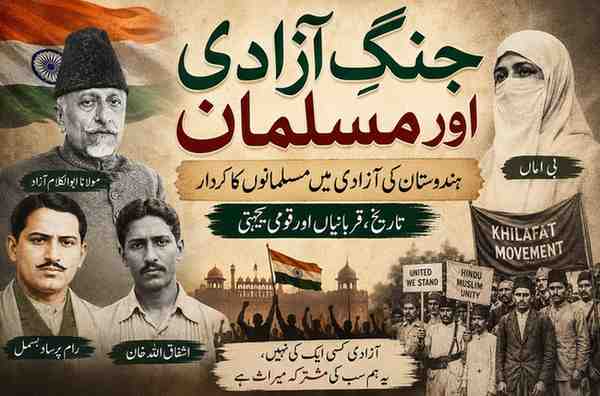
ہندوستان کی جنگِ آزادی میں مسلمانوں کے کردار اور قربانیوں کی مکمل داستان۔ مولانا ابوالکلام آزاد، اشفاق اللہ…
Was Maulana Mohammad Ali Jauhar a Supporter of Pakistan? What History Actually Says
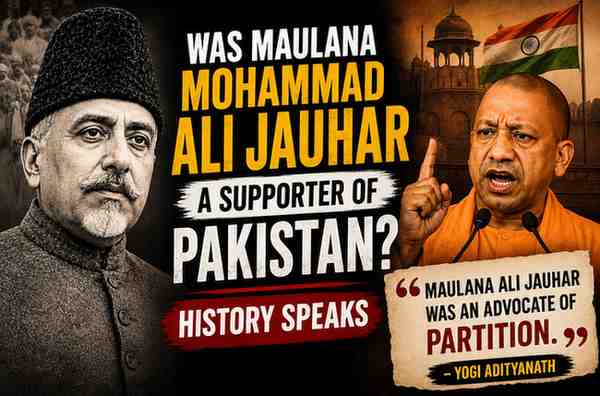
Maulana Mohammad Ali Jauhar is back in the news, not because of a new chapter in his life, but because of a political debate about how his legacy should be remembered. Recent remarks by Uttar Pradesh Chief Minister Yogi Adityanath have described Jauhar in the context of Partition. That claim deserves to be examined carefully, because Jauhar’s political career was much more complicated than a single label suggests.
What did Yogi Adityanath say?
On 14 August 2026, during a programme in Rampur, Yogi Adityanath referred to Maulana Mohammad Ali Jauhar while discussing the political legacy associated with Jauhar University and Samajwadi Party leader Azam Khan. Contemporary reporting described the remark as portraying Jauhar as an advocate or proponent of Partition.
There is an important distinction here. Reporting on the 14 August remarks should not be casually rewritten as though the Chief Minister used every later political label in exactly those words. The responsible question is what was actually said, and then whether the historical characterization is fair.
The first fact we should remember: Jauhar died in 1931
Mohammad Ali Jauhar died in London on 4 January 1931. Pakistan was created in 1947. The Lahore Resolution associated with the Pakistan movement was adopted in 1940, nine years after his death.
- 1878: Mohammad Ali Jauhar was born in Rampur.
- 1923: He served as President of the Indian National Congress.
- 1930: He took part in the Round Table Conference in London.
- 4 January 1931: He died in London.
- 1940: The Lahore Resolution was adopted.
- 1947: Pakistan came into existence.
This timeline does not mean that Jauhar had no Muslim political position. He clearly did. He was associated with the Muslim League and strongly argued for Muslim political rights and representation. But it does mean that we should be careful about describing him as a supporter of the specific state of Pakistan that emerged in 1947.
Was Mohammad Ali Jauhar a freedom fighter?
Yes. Jauhar was an important figure in India’s anti-colonial political movement. He opposed British rule, played a leading role in the Khilafat Movement, faced imprisonment and used journalism to mobilise public opinion.
His political identity was not limited to one organisation. He was associated with the All-India Muslim League, but he also became President of the Indian National Congress in 1923. His career reflects the complicated politics of India in the 1910s and 1920s, when leaders with different long-term visions sometimes worked together against British rule.
His role in the Khilafat Movement
Jauhar and his brother, Maulana Shaukat Ali, were among the best-known leaders of the Khilafat Movement. The movement emerged around the future of the Ottoman Caliphate after the First World War and became a major force in Indian Muslim politics.
In India, the Khilafat campaign also became connected with wider opposition to British rule. The Ali brothers worked with other political leaders during a period when the Khilafat and Non-Cooperation movements overlapped. Whatever one thinks of the movement itself, it is impossible to discuss Jauhar’s political life without acknowledging this anti-British activity.
A journalist who challenged British rule
Jauhar understood that political change also depended on public opinion. He founded the English-language newspaper The Comrade and later the Urdu newspaper Hamdard. Through journalism, he criticised British policies and encouraged political awareness among Indian Muslims.
For Jauhar, the newspaper was not simply a place for daily news. It was a platform for political argument, public education and resistance to colonial rule. That part of his legacy is often forgotten when modern political debates focus only on Partition.
He also led the Indian National Congress
One of the most important facts about Jauhar is that he served as President of the Indian National Congress in 1923. That fact alone should make us cautious about reducing his entire political life to a later Partition narrative.
His Congress leadership does not erase his Muslim political identity or his association with the Muslim League. Instead, it shows how fluid and complicated Indian politics was before the 1940s. Historical figures should be understood in the political environment in which they actually lived.
What about his Muslim League politics?
It would be equally wrong to present Jauhar as though he had no separatist or Muslim political concerns. He was closely associated with the Muslim League and advocated political safeguards and representation for Muslims.
This is precisely why a serious article should not turn him into a saint or a villain. His political views deserve debate. His support for Muslim political rights deserves to be acknowledged. His disagreements with Congress and other leaders should also be discussed.
Did he support the Pakistan created in 1947?
Here chronology becomes decisive. Jauhar died in 1931, while Pakistan was established in 1947. Therefore, he could not have supported the final form of the Pakistani state as it came into existence sixteen years after his death.
A more historically careful description is this: Mohammad Ali Jauhar was a prominent Muslim political leader who advocated Muslim political rights and was associated with the Muslim League, while also taking part in India’s anti-British freedom movement. He died long before Pakistan was established in 1947.
Why the recent characterization deserves criticism
We should be able to criticise a historical figure without rewriting his life. If a freedom fighter opposed British rule, endured imprisonment, led political movements, ran newspapers and served as Congress president, those facts remain part of his historical record even when we disagree with some of his political ideas.
For that reason, we believe it is unfair to reduce Mohammad Ali Jauhar’s entire legacy to a single label connected with Partition. That criticism is not a defence of every position he ever took. It is a defence of historical accuracy.
A word about Yogi Adityanath’s earlier remarks
The 14 August 2026 remarks should also be distinguished from an earlier statement reported in November 2025, when Yogi Adityanath discussed Jauhar’s position on Vande Mataram during the 1923 Congress session and linked that episode to the later Partition.
The Partition of India was the result of a long and deeply complicated political process involving the British government, Congress, the Muslim League, constitutional negotiations, elections, competing political demands and the events of the 1940s. It is difficult to defend a historical explanation that reduces that entire process to one individual’s position on a song in 1923.
Freedom fighters deserve accurate history
There is nothing wrong with political disagreement. There is nothing wrong with examining the difficult parts of a freedom fighter’s record. In fact, honest history requires it.
What is wrong is presenting a complicated historical figure through a modern political label and leaving out the parts of his life that do not fit that label.
Mohammad Ali Jauhar’s contribution to the anti-colonial movement belongs to India’s history. His Muslim political identity belongs to that history too. His disagreements with other leaders belong to it. So do the debates surrounding his political ideas.
What can today’s generation learn from Jauhar?
- Education can give people the confidence to participate in public life.
- Journalism can shape political awareness.
- Political disagreement does not erase a person’s other contributions.
- Historical figures should be judged in the context of their own time.
- India’s freedom movement included people with very different political and religious backgrounds.
Conclusion
Maulana Mohammad Ali Jauhar was a complex political figure: a Muslim leader, journalist, Khilafat Movement leader, Muslim League politician and a participant in India’s struggle against British colonial rule. He also served as President of the Indian National Congress in 1923.
We can debate his political ideas. We can examine his relationship with the Muslim League. But we should not erase his role in the freedom movement or pretend that the political Pakistan of 1947 already existed during his lifetime.
Jauhar died in 1931. Pakistan was created in 1947. That simple timeline matters.
For NafisFlahi, the lesson is straightforward: political debate is healthy, but history deserves evidence, context and honesty.