How to Generate Free AI Videos Using Google Flow in 2026
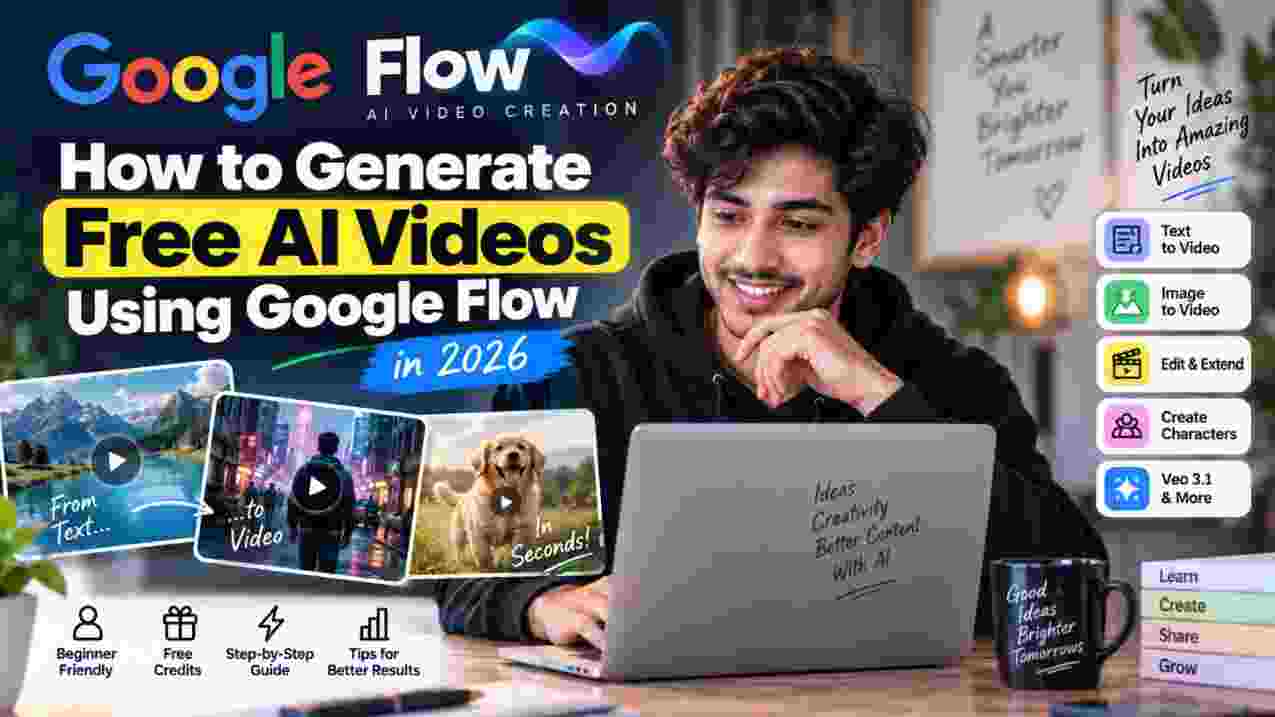
If you’ve been looking for a simple way to create AI videos without immediately paying for expensive video software, Google Flow is worth a look.
Google Flow is designed to help creators turn ideas, images, and written instructions into video scenes. It can be useful for beginners, bloggers, YouTubers, and social media creators who want to experiment with AI video without building everything from scratch.
There is one important detail to understand before you start: free does not mean unlimited. Google Flow uses credits, so the number of videos you can create depends on the available credit allowance and the generation you choose.
In this guide, I’ll walk you through how to use Google Flow, how to generate your first AI video, how to write better prompts, how to use images as references, and how to make your free credits last longer.
Table of Contents
- What Is Google Flow?
- Is Google Flow Really Free?
- What You Get With the Free Version
- How to Start Using Google Flow
- How to Generate Your First AI Video
- How to Write Better Google Flow Prompts
- How to Create a Video From an Image
- How to Keep Characters and Scenes Consistent
- How to Create Vertical Videos for Shorts and Reels
- How to Save Your Free Credits
- Common Google Flow Mistakes
- A Simple Free AI Video Workflow
- Is Google Flow Good for Social Media?
- Frequently Asked Questions
- Final Thoughts
What Is Google Flow?
Google Flow is Google’s AI creative workspace for making and working with AI-generated images and videos. It is built around Google’s generative AI models and is designed around creating scenes rather than simply producing one finished video from a single sentence.
Depending on the features available to your account, Flow can provide workflows such as text-to-video, image or frame-based video generation, reference images, video extension, editing, and scene building.
That makes it useful when you want to create several short clips and then edit them together into a larger video.
Is Google Flow Really Free?
Google currently provides a free way to try Flow with a Google Account. The free experience uses daily Flow credits rather than unlimited generation.
Google’s current Flow information lists 50 daily Flow credits for the free tier. The exact features, limits, models, and availability can change, so check Google’s current Flow page before planning a large project.
Also remember that 50 credits does not mean 50 videos. Different generations can consume different amounts of credits.
What You Get With the Free Version
Google’s current free Flow offering includes access to AI video and image creation features, with the exact availability depending on the current product configuration.
- Daily Flow credits
- Veo model access where included in the current free tier
- Text-to-video generation
- Reference and image-based workflows
- Video extension and editing features where available
- Scene-building tools
Because Google continues to update Flow, some tools and limits may change after this article is published.
How to Start Using Google Flow
Step 1: Sign In
Open Google Flow and sign in with your Google Account. The tools shown on your screen can vary depending on your account and Google’s current rollout.
Step 2: Create a Project
Start a new project and give it a simple name. If you’re learning, don’t begin with a complicated film. A single short scene is enough for your first test.
Step 3: Choose Your Generation Method
For a first experiment, text-to-video is usually the easiest place to start. Type a clear description of the scene and generate a clip.
How to Generate Your First AI Video
Let’s say you want a cinematic shot of a young man walking through a city at night after rain.
A weak prompt would be: “Man walking in city.”
A more useful prompt would be: “A cinematic nighttime scene of a young man walking through a busy city street after light rain. Wet pavement reflects shop lights, people pass with umbrellas, realistic natural movement, subtle handheld camera movement, shallow depth of field, realistic lighting, cinematic composition.”
The second prompt tells the model more about the subject, setting, movement, lighting, and camera. That gives you much more control over the intended scene.
How to Write Better Google Flow Prompts
You don’t need complicated prompt formulas. A simple structure is enough: Subject + Action + Environment + Camera + Lighting + Style + Audio.
For example: “A young woman sitting beside a cafe window while rain falls outside, warm indoor lighting, close-up camera, slow camera push-in, realistic facial expression, cinematic photography, natural cafe ambience and rain sounds.”
- Subject: Who or what is in the scene?
- Action: What is happening?
- Environment: Where is it happening?
- Camera: How should the camera move or frame the subject?
- Lighting: What should the light look like?
- Style: Should it feel realistic, cinematic, documentary, or something else?
- Audio: What sounds should be present when supported?
How to Create a Video From an Image
One of the useful approaches in AI video is starting with an image instead of asking the model to invent every visual detail from text.
You can use a character image, product image, location, illustration, or another suitable reference and then describe the movement you want.
For example: “The man slowly turns toward the camera while his jacket moves naturally in the wind. Clouds move across the mountain behind him. The camera gently pushes forward. Realistic natural movement and cinematic lighting.”
How to Keep Characters and Scenes Consistent
Character consistency has always been one of the frustrating parts of AI video. You may create a character in one clip and get a noticeably different person in the next.
Reference-image workflows can help. If you are creating a story with the same character, use a strong reference and keep important details consistent.
- Clothing
- Hair
- Age and appearance
- Important props
- Location
- Visual style
Consistency is not guaranteed, but careful references and descriptions can make a multi-scene project easier to manage.
How to Create Vertical Videos for Shorts and Reels
If your goal is YouTube Shorts, Instagram Reels, or another mobile-first platform, think about the vertical frame before generating the clip.
When a portrait or 9:16 option is available for your selected workflow, use it for mobile-first content. Keep the main subject away from the edges and make sure important details remain visible in a narrow frame.
A useful prompt might be: “A cinematic vertical video of a young man walking through a busy street market at sunset, realistic movement, warm evening light, gentle handheld camera movement, detailed background, natural crowd motion, composed for a 9:16 mobile frame.”
How to Save Your Free Credits
If you’re using the free tier, don’t spend your credits generating random variations without a plan.
- Decide what the scene should show before generating it.
- Write the prompt with the important visual details.
- Use a reference image when consistency matters.
- Test one scene before planning a large project.
- Save strong results so you don’t have to recreate them unnecessarily.
The goal isn’t to use every credit as quickly as possible. The goal is to get useful footage from the credits you have.
Common Google Flow Mistakes
Using Very Short Prompts
“Make a cinematic video” doesn’t tell Flow what you actually want. Describe the subject, action, environment, and camera.
Trying to Generate an Entire Story at Once
For a larger project, think in scenes. Create individual clips and combine them later in a video editor. This gives you much more control over the final result.
Changing the Character Between Scenes
Keep your references and important character descriptions consistent when you want the same person to appear across several clips.
Ignoring the Camera
Camera direction can make a major difference. Try descriptions such as a slow push-in, wide establishing shot, close-up, tracking shot, or gentle handheld movement.
A Simple Free AI Video Workflow
If you’re completely new to AI video, keep your first project small.
- Choose one idea. Start with a simple concept.
- Break it into scenes. Decide what happens in each clip.
- Prepare reference images. Use them when character or object consistency matters.
- Write a prompt for each scene. Include the important visual and camera details.
- Generate individual clips. Don’t try to create the entire finished video in one generation.
- Review each clip. Check movement, characters, background, lighting, and unwanted details.
- Edit the clips together. Use your preferred video editor to create the final sequence.
This workflow is also a good way to avoid wasting free credits. You know what you want before you start generating.
Is Google Flow Good for Social Media?
It can be useful for short-form content such as YouTube Shorts, Instagram Reels, promotional clips, educational scenes, storytelling, product concepts, and visual backgrounds.
For social media, creating several short clips can be more practical than trying to generate one long finished video. You can select the best moments and control the final edit yourself.
Frequently Asked Questions
Is Google Flow free?
Google currently offers a free Flow tier with daily credits. It is not unlimited free video generation.
How many free credits does Google Flow give?
Google currently lists 50 daily Flow credits for the free tier. Credit costs can vary by generation, so this should not be interpreted as 50 videos per day.
Can Google Flow generate videos from text?
Yes. Text-to-video is one of the video-generation workflows available in Flow.
Can I turn an image into a video?
Flow supports image and reference-based video workflows, depending on the current tools available to your account.
Can I create Shorts with Google Flow?
Yes. When portrait output is available in your selected workflow, it can be useful for mobile-first short-form content.
Can I make a long movie with Google Flow?
You can build a larger project from multiple generated scenes, but a polished long video still requires planning, multiple generations, editing, and careful attention to consistency.
Final Thoughts
Google Flow makes it easier for beginners to experiment with AI video without immediately committing to a paid workflow. The current free tier gives users a daily credit allowance, which is enough to learn the basics and test different ideas.
Just remember that free credits are limited. Plan your scenes, write clear prompts, use reference images when useful, and create individual clips instead of trying to make an entire production in one generation.
Once you understand the basics, you can move from simple experiments to short stories, social media videos, educational clips, and more structured projects.
Start with one short scene, see what works, and build from there.